
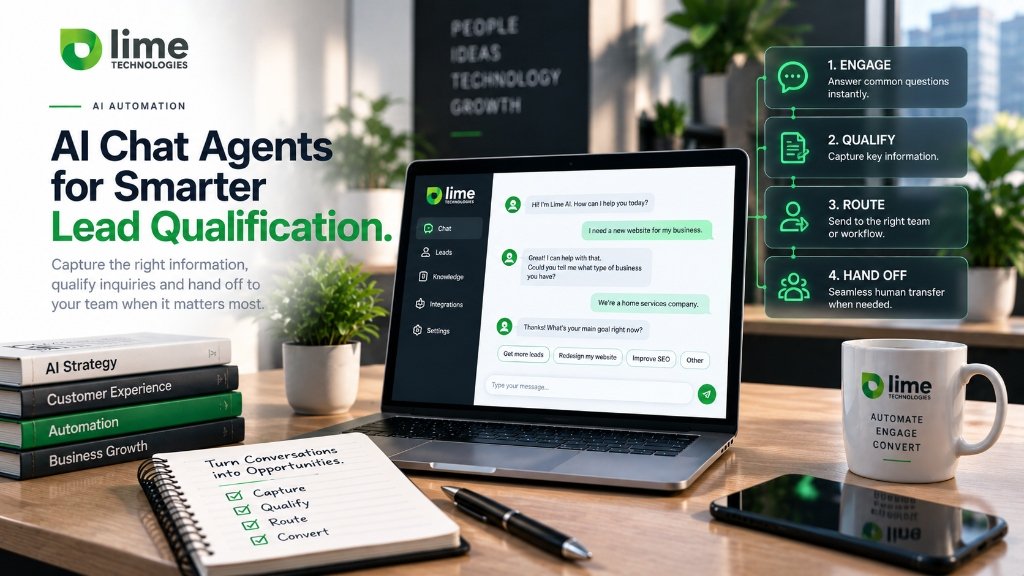
AI chat agents qualify inbound leads effectively by answering verified technical questions, capturing structured business criteria (budget, timeline, scope, company profile), and routing high-intent prospects directly to sales teams. Successful implementation requires strict operational guardrails: the AI should automate routine information gathering and standard qualification criteria, while escalating complex technical requirements, pricing negotiations, sensitive inquiries, or frustrated visitors to human specialists immediately. Human judgment remains central to closing relationships.
Inbound website visitors frequently arrive with urgent questions. They want to know whether your firm offers specific technical capabilities, how your process operates, what timeline constraints exist, and whether their budget aligns with your service tier.
Traditionally, companies faced a frustrating tradeoff: deploy rigid rule-based chatbots that frustrate buyers with scripted decision trees, or rely entirely on human staff who cannot monitor chat inquiries around the clock. The arrival of modern Large Language Model (LLM) agents provides a third pathway: intelligent conversational agents capable of comprehending natural language, referencing verified documentation, and qualifying prospective buyers conversationally.
However, deploying conversational AI without strict operational boundaries creates substantial risk. At Lime Technologies, our AI chat agent implementations follow a disciplined principle: automate qualification and discovery, but preserve human judgment for commercial relationships.
What AI Chat Should Automate vs What Demands Human Expertise
The table below outlines clear operational boundaries for enterprise lead qualification:
| Interaction Stage | Automate via AI Chat Agent | Escalate to Human Specialist |
|---|---|---|
| Initial Inbound Inquiry | Answering verified capability questions, explaining delivery methodologies, referencing public pricing structures. | Custom contract negotiations, requests for legal terms, complex bespoke architectural scoping. |
| Lead Qualification | Gathering structured data: company domain, project goals, timeline horizon, estimated budget bracket. | Evaluating subjective organizational fit, assessing strategic partnership viability, discretionary discounting. |
| Meeting Scheduling | Syncing calendar availability, validating email credentials, booking initial discovery consultations. | High-stakes executive meetings, custom multi-stakeholder panel scheduling, RFP pitch coordination. |
| Customer Frustration | Detecting negative sentiment or repetitive confusion, providing immediate empathetic apology. | Immediate priority takeover by an experienced account executive; never allow a looping bot interaction. |
Defining Structured Lead Qualification Parameters
An effective AI chat agent does not conduct open-ended social banter. It operates with a clear objective: gathering the necessary parameters to determine whether an inquiry matches your Ideal Customer Profile (ICP).
We configure agents to gather four core qualification pillars:
- Problem Definition: What specific operational, technical, or commercial problem is the organization attempting to solve?
- Current Technical Environment: What existing CMS, tech stack, CRM, or cloud infrastructure does the business currently operate?
- Timeline Constraints: Does the prospect operate under an immediate hard deadline (e.g., contract renewal, product launch date) or an exploratory research window?
- Budget Range: Does the prospective engagement align with the firm’s minimum engagement threshold? (Gathered tactfully through structured investment tier options).
Establishing Guardrails: Knowledge Boundaries and Hallucination Mitigation
The primary danger in deploying conversational AI is algorithmic hallucination—an LLM inventing non-existent service guarantees, promising unrealistic timelines, or quoting fabricated pricing discounts.
To eliminate hallucinations, we deploy Retrieval-Augmented Generation (RAG) architecture with strict systemic guardrails:
- Restricted Knowledge Corpus: The agent is permitted to answer questions only from verified documentation: service specifications, official FAQs, case summaries, and published pricing guidelines.
- Explicit Refusal Instructions: System prompts explicitly direct the agent to state: “That detail depends on customized project scoping. Let me connect you directly with our engineering team to provide an exact evaluation.”
- Zero Fabrication Tolerance: The agent is technically forbidden from estimating delivery dates or quoting custom dollar figures that do not exist within verified parameters.
- Identity Transparency: The chat agent must always introduce itself honestly as an automated assistant. Attempting to deceive prospective clients by pretending an AI bot is a human staff member destroys trust before a conversation even begins.
Designing Deterministic Human Escalation Triggers
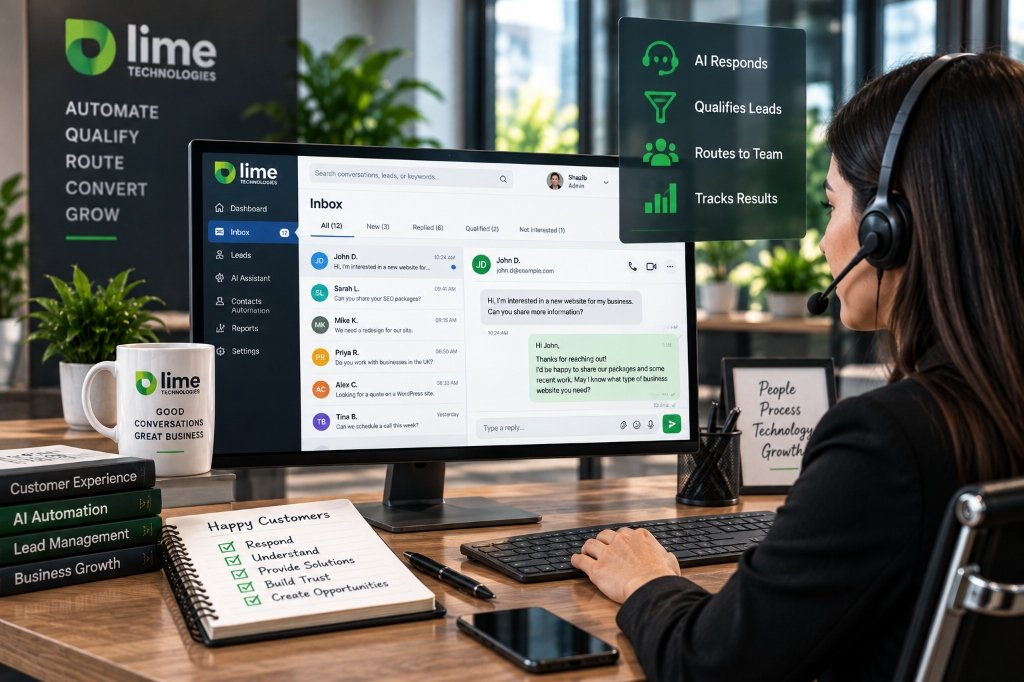
An automated system is only as reliable as its handoff mechanism. When specific conditions are met, the agent must trigger a seamless human escalation:
- High-Intent Commercial Signals: The prospect confirms a budget exceeding enterprise thresholds and requests immediate technical review.
- Explicit Request for Human Assistance: If a user types “speak to a person”, “talk to sales”, or “representative”, the bot must immediately display a direct booking calendar or initiate live chat transfer.
- Sentiment Distress: If the model identifies negative sentiment, repeated clarification questions, or frustration indicators, it ceases automated questioning and escalates.
- Out-of-Scope Technical Queries: Questions requiring customized architectural engineering or security compliance sign-off route directly to technical leads.
Data Governance, Privacy, and CRM Integration
A conversation locked inside a chat widget provides minimal commercial value. Automated agents must integrate directly with your operational infrastructure:
When qualification parameters are gathered, the agent structures the payload as clean JSON and dispatches it via secure webhook to your CRM (HubSpot, Salesforce, or custom database). The sales representative receives the full transcript alongside structured fields: verified company name, target timeline, budget tier, and summary of expressed pain points. The human team enters the discovery call fully briefed without requiring the client to repeat basic information.
Organizations seeking to build integrated software workflows can review our digital product engineering practice, or explore our full suite of technical capabilities on the Services Hub.
- Qualify, do not close: Automate data collection, capability validation, and scheduling; leave complex commercial negotiations to experienced human teams.
- Restrict knowledge boundaries: Use verified RAG architecture to prevent hallucinations and enforce strict refusal protocols for unknown questions.
- Always declare AI identity: Transparency builds immediate credibility; never disguise an automated agent as a human staff member.
- Sync structured data to CRM: Pass structured qualification parameters directly to sales reps so discovery calls start with full context.