
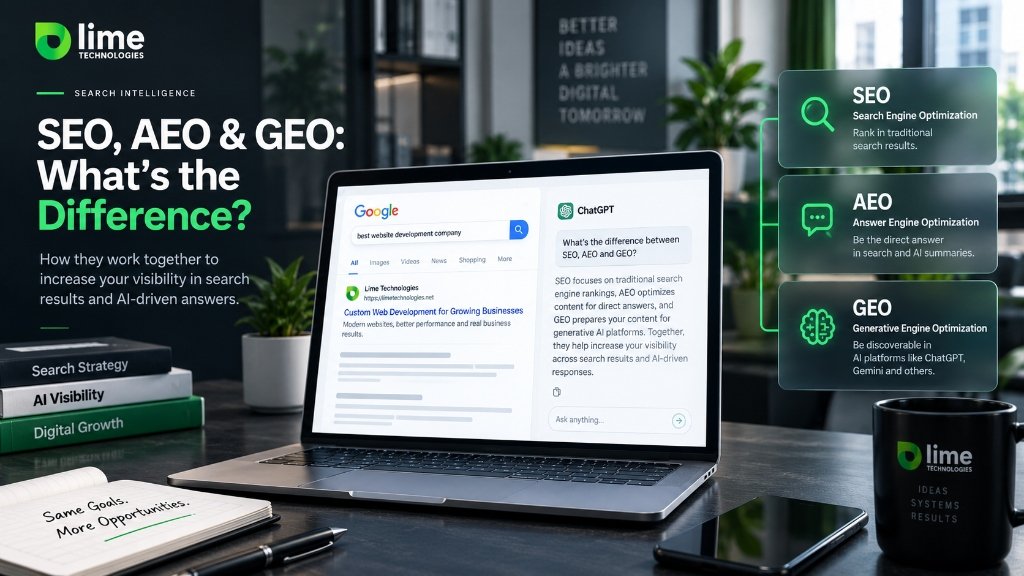
Search Engine Optimization (SEO), Answer Engine Optimization (AEO), and Generative Engine Optimization (GEO) are complementary layers of search visibility. SEO optimizes websites for traditional search crawlers and ranked link results. AEO structures concise, factual content for direct extraction into answer boxes, featured snippets, and voice responses. GEO organizes verifiable entity information, factual density, and clear structural context for retrieval by large language models and generative search synthesizers. AEO and GEO build upon SEO rather than replacing it.
Search interfaces are experiencing significant structural evolution. Where search engines once displayed ten blue organic links accompanied by text ads, modern discovery platforms now present algorithmic answer snippets, synthesized knowledge panels, and generative conversational summaries alongside organic listings.
This transition has introduced new terminology into marketing discussions, notably Answer Engine Optimization (AEO) and Generative Engine Optimization (GEO). While some commentators prematurely claim these acronyms make classic Search Engine Optimization (SEO) obsolete, practitioner reality is far more grounded. At Lime Technologies, we view SEO, AEO, and GEO not as competing methodologies, but as consecutive layers of an integrated information retrieval discipline.
Defining the Disciplines: Working Frameworks, Not Official Algorithms
It is essential to clarify an important technical nuance: while SEO references decades of documented search engine indexing and ranking principles, AEO and GEO are industry-devised working disciplines rather than official algorithmic systems published by Google, Microsoft, or OpenAI.
Understanding how each layer operates clarifies where digital investment should focus:
- SEO (Search Engine Optimization): The discipline of optimizing web architecture, indexability, topical depth, and external authority to earn visibility in traditional ranked search engine results pages (SERPs).
- AEO (Answer Engine Optimization): The tactical structuring of concise, high-confidence factual passages designed to be extracted verbatim into Google Featured Snippets, Knowledge Panels, People Also Ask dropdowns, and voice assistants.
- GEO (Generative Engine Optimization): The practice of establishing verifiable entity authority, dense factual context, clear citation sources, and crawlable text structures so generative AI synthesizers (such as Google AI Overviews, Perplexity, or ChatGPT Search) retrieve and reference your business as a trusted source.
Comparison Matrix: SEO vs AEO vs GEO
The table below outlines how objectives, surfaces, content structures, and technical foundations differ across the three visibility layers:
| Dimension | SEO (Search Engine Optimization) | AEO (Answer Engine Optimization) | GEO (Generative Engine Optimization) |
|---|---|---|---|
| Primary Goal | Drive qualified organic impressions and click-through traffic to website landing pages. | Win zero-click featured answers, snippet placements, and voice assistant responses. | Ensure brand entity inclusion, factual retrieval, and citation in AI-generated answers. |
| Typical Surface | Traditional organic search listings, localized map packs, image/video carousels. | Google Featured Snippets (paragraphs, lists, tables), Knowledge Cards, Siri/Google Assistant. | Google AI Overviews, Perplexity answer engines, ChatGPT Search, Gemini summaries. |
| Content Structure | Comprehensive long-form pages, topical clusters, service landing pages with conversion forms. | Question-and-answer format, 40–80 word direct answer blocks, ordered lists, comparison tables. | Information-dense paragraphs, verified claims, primary source citations, entity-rich definitions. |
| Technical Foundations | Crawlability, clean URL hierarchy, fast page speed, mobile parity, XML sitemaps, 301 redirects. | Semantic HTML5 (lists, tables, dl), targeted Schema.org markup (FAQPage, HowTo, QAPage). | Clear entity graph references, authoritative external citations, machine-readable plain text, robust schema. |
| Success Indicators | Organic clicks, keyword rank distribution, organic conversion volume, domain visibility. | Featured snippet ownership, zero-click impressions, voice query trigger frequency. | LLM citation occurrences, brand mention sentiment in synthesized answers, referral traffic from AI bots. |
Common Industry Misconceptions
Rapid changes in search presentation frequently generate widespread industry hype. Evaluating common fallacies helps organizations avoid misallocating technical resources:
- Misconception: “SEO is Dead”: Traditional search indexing remains the foundation of web traffic. Generative search engines do not operate independently of web crawlers; they rely on index databases built through standard crawling infrastructure. Without sound technical SEO, neither AEO nor GEO is possible.
- Misconception: “AEO Replaces SEO”: Answer extraction handles specific, definitional, or factual queries. High-intent commercial queries—such as purchasing software, hiring an agency, or exploring custom services—continue to drive users to full landing pages where detailed technical evaluation and conversion occur.
- Misconception: “GEO Guarantees Citations”: No optimization technique can guarantee that a generative model will cite a specific domain. Large language models synthesize information probabilistically based on training weights and real-time retrieval-augmented generation (RAG). Optimization increases the likelihood of retrieval; it does not buy algorithmic certainty.
- Misconception: “Structured Data Automatically Ranks Content”: Adding Schema.org JSON-LD assists search engines in disambiguating entity relationships and page types, but structured data cannot compensate for thin content, poor technical performance, or lack of domain authority.

Building a Unified Content Architecture for Multi-Surface Retrieval
Rather than creating separate content silos for SEO, AEO, and GEO, forward-thinking organizations build unified editorial architectures that satisfy all three retrieval paradigms simultaneously.
In our search engine optimization practice, we implement a three-tiered structural model on every informative page:
- Tier 1 — The Direct Answer (AEO): Place an explicit, factual answer block directly below the primary H1 heading. Answer the core query in 40 to 80 words of clear, declarative prose. Use standard HTML paragraphs without conversational padding.
- Tier 2 — Substantive Context & Analysis (SEO): Follow the direct answer with structured H2 sections exploring nuances, methodologies, edge cases, and step-by-step procedures. This provides the comprehensive topical depth that search engine ranking algorithms evaluate for traditional link placement.
- Tier 3 — Factual Density & Entity Clarity (GEO): Incorporate structured comparison tables, bulleted technical specifications, and clearly defined operational terminology. Generative models retrieve dense, structured data much more reliably than ambiguous marketing prose.
When undertaking major structural updates or platform overhauls, reviewing our Website Redesign SEO Migration Checklist will help ensure historical search signals remain protected across all surfaces. You can also explore our full range of technical services on the Services Hub.
- SEO is the foundation: Crawlability, indexability, and clean HTML semantics remain prerequisite requirements for both AEO and GEO.
- AEO captures immediate demand: Clear, concise direct-answer blocks win featured snippets and voice query visibility.
- GEO requires factual density: Generative models favor entity-rich, authoritative, and structured text over generic marketing copy.
- A single page can serve all three: Layering direct answers, in-depth analysis, and structured comparison tables creates multi-surface resilience.