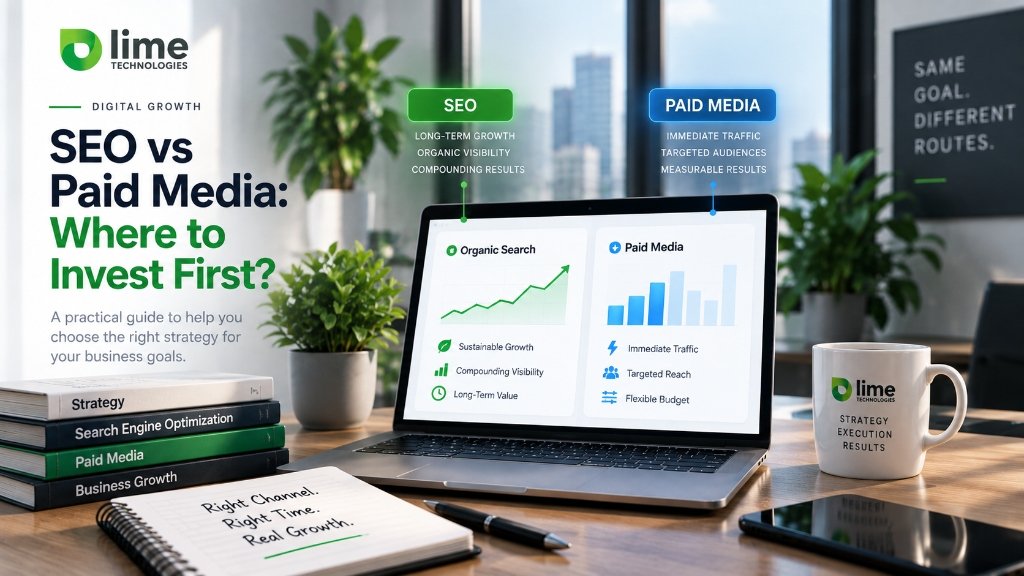
Deciding whether to invest in SEO or paid media first depends on business timeline, existing market demand, conversion readiness, and capital availability. Paid media delivers immediate testing, rapid audience feedback, and controllable traffic volume, but requires ongoing media expenditure. SEO builds compounding organic visibility, sustained authority, and reduced customer acquisition costs over time, but requires patience and foundational technical readiness. Most organizations benefit from starting with paid media to validate messaging and landing pages, transitioning to SEO for sustainable compounding value.
When leadership teams allocate digital growth capital, the debate frequently centers on a false dichotomy: should the organization invest in organic Search Engine Optimization (SEO) or Paid Media advertising?
Proponents of SEO praise the compounding nature of organic traffic and the absence of per-click media costs. Advocates of paid advertising emphasize immediate distribution, precise audience targeting, and immediate feedback loops. The reality is that neither channel is universally superior; each solves fundamentally different commercial problems at different stages of business maturity.
The Core Economic Tradeoff: Immediate Testing vs Compounding Equity
Understanding how capital behaves in organic versus paid marketing is essential for sound financial planning:
- Paid Media Operates as an Operational Expense (OpEx): You pay for immediate exposure. Traffic begins within minutes of campaign activation and ceases the moment budget runs dry. It functions like renting attention: flexible, highly controllable, but with zero residual equity once payments stop.
- SEO Operates as a Capital Investment (CapEx): You invest upfront in digital assets: technical infrastructure, content architecture, authoritative research, and site performance. Traffic takes months to accumulate, but once established, high-performing organic assets continue generating qualified leads with minimal marginal cost per visitor.
Comparison Matrix: Investment Dimensions
The table below compares the critical operating characteristics of SEO and Paid Media:
| Dimension | Search Engine Optimization (SEO) | Paid Media & Advertising |
|---|---|---|
| Time to First Traffic | 3 to 9 months for meaningful organic ranking consolidation. | Minutes to hours after ad approval and budget launch. |
| Capital Model | Upfront investment in technical assets, content, and authority. | Continuous operational spend; media cost incurred per click or impression. |
| Traffic Control | Subject to algorithmic updates, crawler schedules, and competition. | Direct volume control via bids, daily caps, and dayparting. |
| Testing & Learning Speed | Slow; testing new value propositions requires weeks to re-index. | Extremely fast; A/B split test headlines and landing pages in days. |
| Landing Page Dependency | Requires deep topical relevance, fast load speed, and crawlability. | Requires high conversion focus, message match, and clear tracking. |
| Residual Asset Value | High; published content assets continue generating value for years. | None; zero traffic flows when the advertising budget is depleted. |
Key Decision Factors: How to Evaluate Your Readiness
Rather than following generic agency advice, evaluate your organization across four structural readiness criteria:
- Cash Flow Horizon: If your company requires customer acquisitions within the next 30 to 60 days to sustain payroll or inventory, paid media is the only realistic lever. If your business possesses stable core revenues and can commit to a 6- to 12-month development horizon, SEO provides dramatically superior long-term unit economics.
- Message & Offer Validation: If you are launching an unproven product, new service tier, or untested value proposition, do not build an extensive 50-article SEO strategy around an unvalidated assumption. Use paid search or paid social to test messaging against real buyers first. Validate which hooks convert before investing heavily in organic content.
- Conversion Infrastructure Readiness: Pouring paid ad spend into a slow, poorly formatted website with unclear calls to action simply accelerates financial waste. Your website must maintain fast load times, clear service articulation, and seamless lead capture before scaling paid campaigns.
- Search Intent & Market Volume: Does active search demand exist for your solution? If prospects actively search for your service categories (e.g., “industrial logistics consulting” or “medical billing software”), search marketing (both SEO and Google Search Ads) is primed for investment. If your solution is novel and unsearched, paid social and targeted content distribution must generate awareness first.
When Paid Media Makes Sense First
Organizations should prioritize paid media campaigns when:
- You need immediate market entry for a time-sensitive commercial launch or seasonal campaign.
- You need rapid empirical data on which search queries generate the highest commercial conversion rates.
- Your domain is brand new with zero backlink profile and minimal domain authority.
- You are testing multiple pricing models, audience personas, or landing page layouts simultaneously.
When SEO Makes Sense First
Organizations should prioritize search engine optimization when:
- Per-click advertising costs (CPCs) in your industry are prohibitively expensive ($30 to $100+ per click in sectors like legal, finance, or enterprise SaaS).
- You have an established, authority-rich web property with solid technical foundations that simply lacks fresh content and structural refinement.
- Your customers undergo extended, research-intensive buying journeys requiring educational content across multiple touchpoints.
- Your goal is building enterprise enterprise valuation through owned digital assets rather than perpetual rented traffic.
The Strategic Synthesis: How Paid and Organic Reinforce Each Other
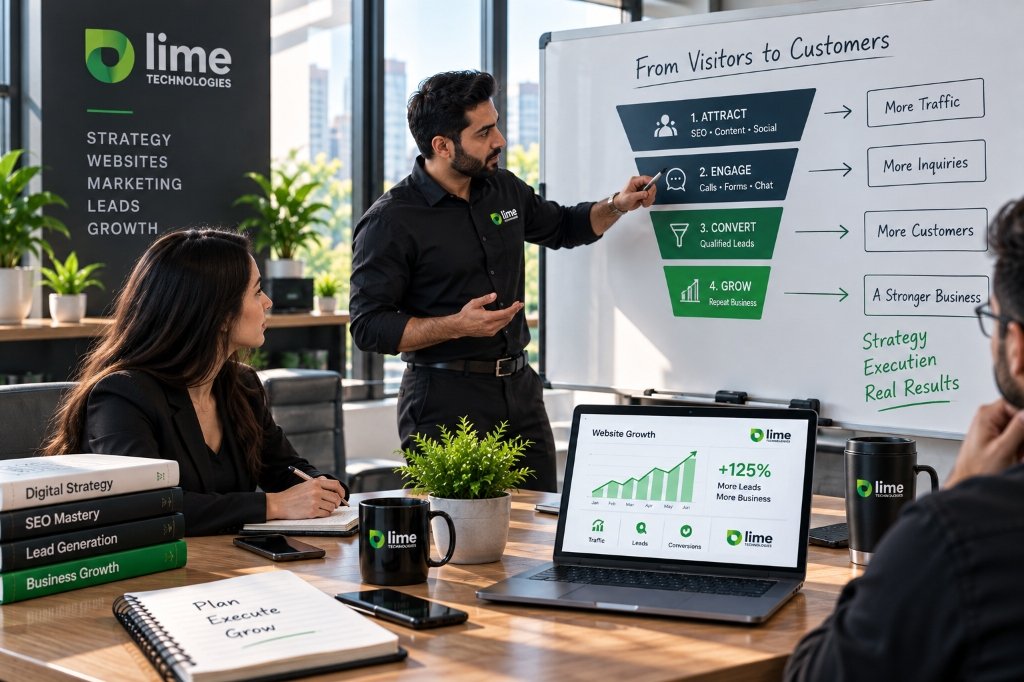
The highest-performing growth architectures do not treat SEO and Paid Media as adversaries; they operate them as an integrated loop:
1. Paid Search Informs Organic Content Strategy: Run Google Search Ads on targeted core themes for 60 days. Extract the exact search query report. Identify which specific long-tail keyword queries produced verified sales inquiries, not merely clicks. Feed these high-converting queries directly into your editorial roadmap to build permanent organic authority.
2. Organic Content Powers Paid Retargeting: Authoritative organic articles attract high-intent researchers. Implement privacy-compliant retargeting pixels to re-engage these educated visitors with targeted paid case studies and conversion offers as they move closer to purchasing.
To evaluate how integrated search and media capabilities fit your operating model, visit the Lime Technologies Services Hub.
- Avoid the false binary: Paid media rents immediate attention; SEO builds compounding equity. Both serve distinct commercial phases.
- Test with paid, compound with organic: Use paid channels to validate messaging, conversion rates, and buyer hooks before investing in deep organic content.
- Beware the high CPC trap: In industries with extreme paid click costs, building organic search authority is an essential defensive necessity.
- Share data across teams: Search query data from paid ad accounts should directly guide organic editorial priorities.